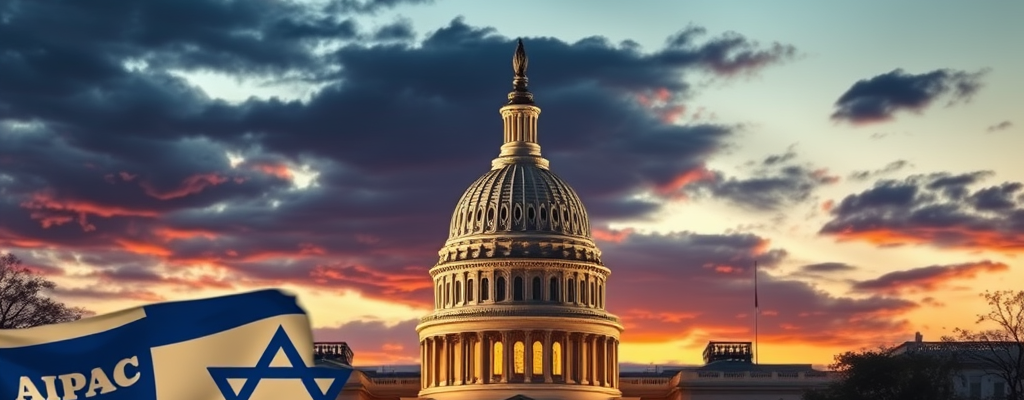
The U.S. Constitution begins with the words “We the people of the United States…” Many question whether “we the people” are actually controlling the destiny of our nation. In this and likely some following posts, I will take a look at the influence that interest groups have on American politics, starting here with the Israel Lobby. The Israel Lobby includes groups like American Israel Public Affairs Committee (AIPAC) and the Zionist Organization of America advocating for policies they believe benefit Israel.
“America First” is what President Trump ran on and is a major reason why he was elected twice. Many Americans feel as if their country is being ripped away from them at the hands of various actors. While some of these positions are overstated at times, and it’s possible that those who are really in control are not being called out, these concerns are very real and legitimate. In looking into some of the major players in our country’s politics, who standout as having an undue influence in our system, The Israel Lobby is towards the top of that list.
For many decades, Israel has been considered one of America’s top global allies, and there have been mounting concerns over the power of the Israel lobby in the United States for several decades. In 2008, John J. Mearsheimer and Stephen M. Walt published a book called The Israel Lobby and U.S. Foreign Policy. In this book, Mearsheimer and Walt laid out how U.S. foreign policy often aligns with Israel’s best interest, how that is largely because of the Israel Lobby’s large influence on our political system, and also argued that the policies that the Israel Lobby has advocated for have harmed both Israel and the United States.
There is a website dedicated to tracking the activities AIPAC, and other Pro-Israel groups in the United States. The website is decidedly against the Israel Lobby, but it provides some interesting information regarding the large amounts of campaign funding that elected officials receive from Pro-Israel groups. According to Track AIPAC, 15% of the U.S. Congress has AIPAC as their top all-time contributor. The Representatives and Senators in this group are almost evenly split between Republicans and Democrats. Track AIPAC also found that President Trump received over 230 million dollars in campaign support from Pro-Israel interest groups.
Surveys of congressional staffers, referenced in The Israel Lobby and U.S. Foreign Policy, reported that AIPAC is the second most powerful lobby in Washington behind AARP. As previously mentioned, this book was published in 2008, but not much seems to have changed in terms of AIPAC’s influence since then given their campaign contribution levels, the current level of U.S. Support for Israel, and statements like this from one U.S. congressman Thomas Massie that “Everybody but me has an AIPAC person… It’s like your babysitter.”
While nothing is illegal about lobbying the federal government and it is an expected part of democracy, how our elected officials are influenced by these groups and the policies that they promote deserves close scrutiny. On face value, it doesn’t seem America First, to put the foreign policy and funding preferences of the Israel lobby ahead of our own. The Israel Lobby not only puts a lot of money into U.S. Elections and is active in Washington… They also get results.
Israel receives significant aid from the United States year after year and the U.S. tends to also pursue foreign policy in the Middle East that benefits Israel. According to foreignassistance.gov, Israel received about 6.8 billion dollars in U.S. assistance in 2024 and has consistently received around 3 billion dollars annually since 2001. This puts them first out of 17 countries in the region, where the average U.S. assistance was 700 million dollars in 2024. Just this year, according to Track AIPAC, President Trump authorized over 14 billion dollars in military aid and weapons sales to Israel.
According to Mearsheimer and Walt’s argument, U.S. policy in the Middle East, including Iran, Syria, Lebanon, and Iraq, has largely reflected Israeli policy preferences and jeopardized U.S. security. Mearsheimer and Walt cover multiple conflicts in these countries in depth, making the case that U.S. actions, regarding our own military and diplomatic operations largely support Israeli interests.
Some may argue that the Israel Lobby’s influence on our politics is positive because Israel is an important strategic asset or Israel is the only country in the region that shares similar moral values to the United States. Mearsheimer and Walt respond, “Washington’s close relationship with Jerusalem makes it harder, not easier, to defeat terrorists who are now targeting the United States, and it simultaneously undermines America’s standing with important allies around the world.”
Even if Mearsheimer and Walt turn out to be wrong on the implications of our own foreign policy decisions, candidates in U.S. elections tend to either tiptoe around the issue of Israel or be explicitly pro-Israel. Presidents and members of Congress from both parties have largely voted to continue funding Israel and rhetorically support Israel. While it may be valid at times to do so, this cannot be seen as an absolute and the influence of Israel on the U.S. is highly unusual when compared to other countries. The America First movement, including President Trump, should reevaluate its ties to the Israel Lobby and answer whether by prioritizing aid and diplomatic support for Israel, they are still being true to America First.
 The Name of Liberty